Saturday, November 9, 2024

Mariatu's Money

Mariatu works down on deck 4 of the ship in the hospital. She is one of our wonderful day crew who come on board to serve in a variety of ways. For her, it is radiology.

Last week was payday, and while it worked for everyone else, she said it didn't go through. "Ugh! I thought we got through all these technical and banking issues." See, day crew are paid through an online mobile payment app (think Venmo Business, but you can pay a massive amount of people). I was out of the office on Friday, so I asked someone on my team to investigate. 

Our system said she was paid. The bank confirmed it. She told Hugo, her manager, she was not paid. So what do you do in moments like these? I never experienced in this in the US — it always just "worked".

The bank said she could come to the bank and discuss, but I could tell it would not be a two-way dialogue. Hugo, Mariatu's manager, came back to me and said if she goes to the bank, then she would have to take a half day to travel and would get nowhere because the bank would not help. Sadly, I think the manager's view is correct. But then the manager said something that brought the real issue into perspective: she has no voice, no agent, no counselor, no support. No one had her back.

See, what Hugo was communicating to me is that while, yes, technically, she could go to the bank to resolve it, nothing would be resolved. If we think there is a breakdown of trust in America or Europe, we still have tons more inherent trust that wrongs will be righted. But for many here, there isn't even a semblance of trust breaking down because there wasn't any to begin with.

Mariatu has no voice. No one would believe her. No one has her back. Hugo was imploring me to go with her to the bank because I have a voice, and if I spoke up, people would listen. Sadly, my "voice" comes from being white and from being American. Mariatu has neither. She was going to be heartbroken and lack a remedy. She, in her mind, would lose her two weeks of pay. She's better off than most: her husband works and has a good job, she does not live in the slums, and she speaks English, among other strengths. Imagine if she lost two weeks of pay and did not have a safety net.

In the end, she did get her money, and it was a technical issue. She received the correct amount on the correct day, but the bank notification failed, and we worked through that. However, though that paycheck has a "happily ever after" ending, her life is marked with being invisible, forgotten, and ignored. Mercy Ships mission statement is "We follow the 2,000-year-old model of Jesus, bringing hope and healing to the world’s forgotten poor.". I like that. However, I always believed it was about the patients and their families. This week I received the opportunity to expand my understanding: it is not just about patients and families, but our day crew such as Mariatu. It is the security guard that I respect at the pizza place. It is Max in the dock — and Moses and Salah, too. It Isatu in the fabric market. It is also the other lady I buy my fabric from, whose name I cannot recall and feel guilt that I cannot (and wish I would strike that sentence so you didn't know I forgot).

The day crew is my mission field. 

Friday, November 8, 2024

Hospital Musings


**Please note, while anyone my read this blog it will be particularly insightful for anyone in the medical world. But really anyone who has experienced American health care will find it interesting, so... continue reading!!**


Working in a hospital, on a ship, in Africa, for free. 


Each part of that sentence is different than anything I was doing a year ago. And each part makes what I do now completely unique in both good and challenging ways. 

For starters, a hospital. While I have worked in hospitals for a few years of my time in physical therapy, most recently I have been in home health. I have driven around to peoples homes hardly seeing any coworkers for the past 5 years. Now working in a hospital again, I have patients on IV poles who are not as medically stable. I check in with nurses, dietitians, hospital physicians, etc before I see a patient. I coordinate my time with them with hospital rounds, shift changes and when they are at CT-scans. On the plus side- coworkers! I love seeing all of those other medical professionals and collaborating with them. 

On a ship. Yes, we are tied up to the dock, but very much on a ship. It doesn't move very much (there are surgeons doing delicate surgery after all!!) but other areas of ship life are very apparent. We have safety drills that call for "abandon ship!" every week. Everything has to be able to be stored and tied down when we are sailing. My cabin, my kids school, my husbands office, the dining room, and where I do my laundry are all just a stairwell away. My commute went from 50-100 miles on my car each work day to going down 4 flights of stairs. 

In Africa. This is the biggest of all of the changes. First of all just being on the other side of the world, away from family and friends. This ship is a community of people from all over the world, so the patients are African but my coworkers are from Australia, New Zealand, the UK, Netherlands, Sweden, and on and on. The patients mostly speak Krio and I use an interpreter for every patient. Our interpreters are "day crew"... local people who are paid by Mercy Ships to be interpreters, housekeepers, cooks, you name it. They are invaluable. 

Being in Africa there is also no health insurance. Staying in the hospital is 100% free for patients so there is no billing portion to my progress notes. I spend however much time a patient needs with them, not based on productivity, MD orders or insurance requirements. If a patient does not meet their goals, we change the goals, we don't discharge the patient. If a patient needs a follow-up x-ray, we go across the hall and get an x-ray with no need to wait for insurance verification. 

Being in Africa also means patients are discharged home to a tin roof hut. Or sometimes a place with no electricity or running water. There is no outpatient physical therapy in their area, or it would cost a months wages to get an AFO. The likelihood of infection is high and education on signs of infection is low. Patients take longer to heal because of poor nutrition. Bones in children take 8-10 MONTHS to heal instead of 8-10 WEEKS. We give them calories and vitamins to take once they are in our care, but it's just not enough after a lifetime of poor nutrition. As a dietician told me this week 'Its like throwing ingredients on top after the cake it already baked". We keep patients for longer in the hospital because followup care is most likely not happening. 

And lastly...For Free. Yep. Not paid. I don't even clock in and out. No W-2 form. I work from 8am-3pm most days without a paycheck. Weird right? Who would do such a thing?!? We joke that everyone on board is a little crazy, and a lot adventurous. But because the ship is run by volunteers (except Day Crew, see above) the people here are fabulous. No one is trying to climb the corporate ladder, get the next promotion or only look out for themselves. Each person believes in something bigger than themselves and wants to be a piece of a larger puzzle. The humility and love onboard is palpable and the patients feel it as well. Chaplins are singing with patients in the hallway, RNs start a dance party with a pediatric patient who is healing all while I am walking patients and giving them new exercises to do. 

Working here is hard. Working here is amazing. Working here is like nothing else I have ever experienced or will experience anywhere in the USA. I'm thankful every time I go downstairs and get to experience the Mercy Ships hospital. 


Questions? Thoughts? Let me know! 

Saturday, October 26, 2024

A Day In The Life


 So... what does it look like to live/sleep/work/eat on a hospital ship in Africa?

While the answer to the question will be different for the over 500 people onboard, here is a brief look at what a weekday for me (Jaclyn) looks like!

07:00-Wake up me and the kids. Jeff is already gone, usually at a bible study or prayer meeting. Mornings are harder for me to do those things, but it works great for Jeffs schedule! Kids and I get dressed, go to the dining room for breakfast, brush teeth and normal getting ready for the day things. 

07:55-Kids leave for school. One of the many benefits of being here is there is no long line of cars I need to wait in, the kids just give me a hug and go upstairs. We live on Deck 8 and the Mercy Ships Academy is on Deck 10. Byeeeee kids!


Here is where is really depends on the day. Sometimes I go downstairs to Rehab in the hospital if they need me, sometimes I am doing laundry, cleaning the cabin, having coffee with others, it really depends on the day! Let's say it's a "Work in Rehab" kind of day....

08:00- Go down to Deck 3, change into scrubs, go to Deck 4 Rehab Gym. See some patients, talk with the team there, etc. Unfortunately I can't take pictures in the hospital for patient privacy reasons, so use your imagination! :) 


11:45- Say bye to Rehab and meet the kids in the dining room on Deck 7. I love being able to have lunch with my kids everyday! After lunch we usually have time to relax in the room for 15 minutes before they head back to school. 


12:45 With the kids back in school until 15:05 (yep, 24 hour clock here!) I either head back to Rehab or start the other chores around the cabin. Since rehab isn't too busy, most of the time I am back home. I vacuum the cabin (it goes fast when it's so small), pick up shoes left on the floor (mom life!) and/or do some laundry. The afternoon goes fast and before I know it kids are back!!

15:05 After school homework time, kids run down to the dining room for a snack (they love "toasties" aka grilled cheese!), and after school clubs/activities. Tuesdays Lauren has theater club and youth group, while Sam has drum lessons. Wednesday is running club (like cross country) for Sam and Sadie, you get the idea. The best part is not having to DRIVE them to any activities like I used to, they just go! Amazing!


17:30 Dinner! Dinner menu is always posted beforehand and has rice, a meat, veggies, a salad bar and maybe 3 times a week dessert. A few times a week we have a family meal where just the 5 of us sit together but the rest of the meals we try to find friends and live in community. 


19:00-After dinner each member of the family runs different ways. Lauren tends to go to the youth lounge (Grades 6-12 only). Sam will go to a friends cabin to hang out or build legos. Sadie will go up to Deck 11 to play outside on the trampoline or swings and Jeff and I will follow her there to chat with other parents.


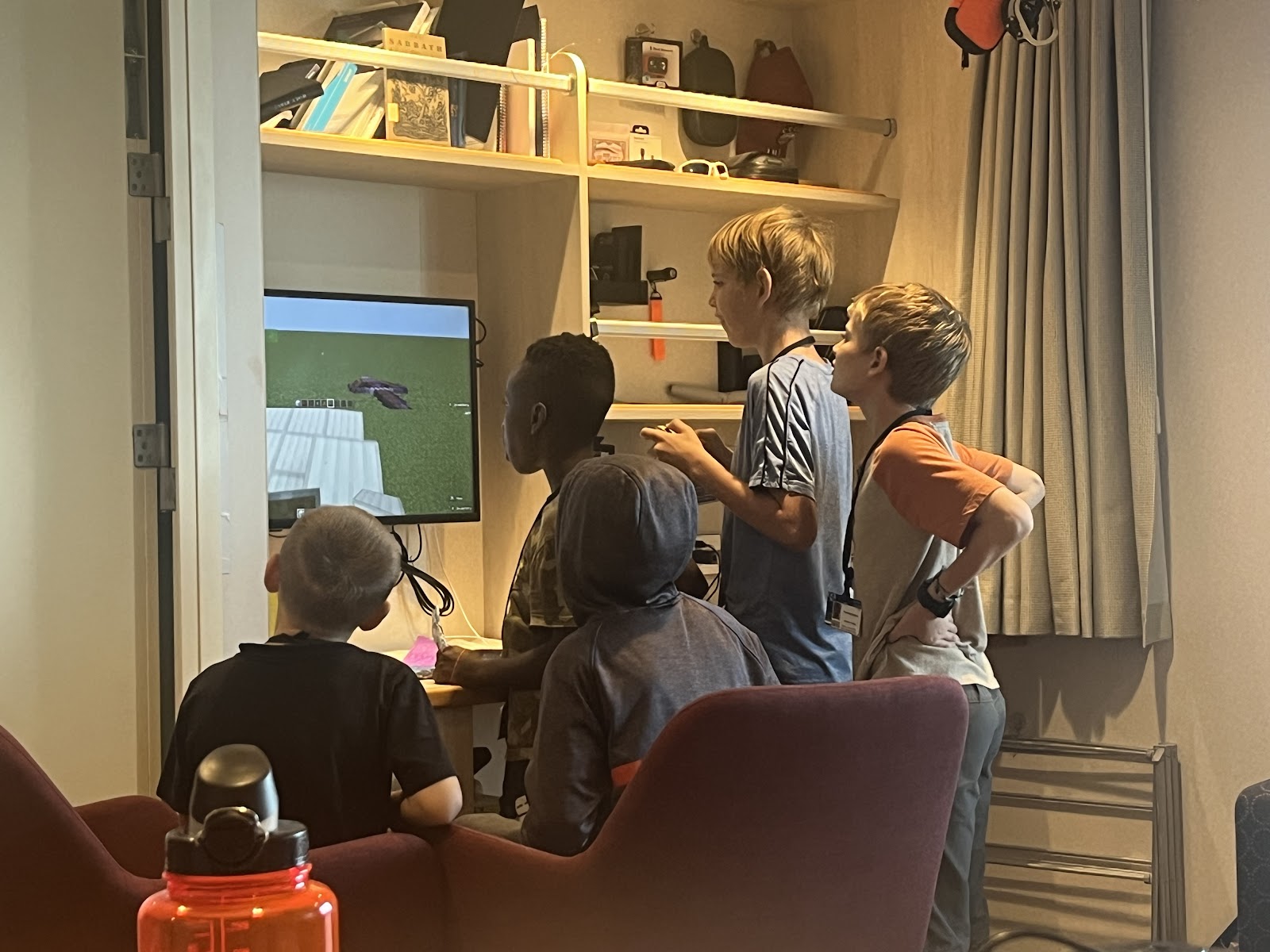
                                                        (Sam and friends playing video games)
 

20:30-Sam and Sadie are in bed and Lauren is reading/drawing in her room. Jeff and I are drinking tea, going to work out in the gym, and catching up on our days. 


As you can see, a lot has stayed the same in our lives but a lot has changed too. We are thankful to be in this amazing community and be a part of something BIG happening in Africa. 

What else do you want to know about our lives here? Let us know!! 

Sunday, September 29, 2024

Money, Day Crew, and a Port Worker Named Max

A brief update:

I'm diving into the finance role and really enjoying it. It's emotionally tough. We hire day crew for roles such as drivers, housekeeping, galley, translators (there are 16 people groups in Sierra Leone, all with their own languages(!!)), etc. Some roles must be locals (translators or those who help us understand the culture), and many to fill the gaps in volunteer numbers.  In all of this, we pay them very well comparatively, but it's still low compared to Western standards. If we pay them too much, we completely upend the economic environment because of what we've created. And then we'll leave in 10 months, leaving the country worse than when we came. So we work to mitigate that by: 

  1. Paying them above average, 
  2. Giving them experience (think internship), 
  3. Helping them get a certificate (such as culinary) to get a good job in town, and
  4. Helping them with a savings account to have money for when the ship leaves
So I love it, but I also deal with a lot of western guilt ("why aren't we paying them more? Why don't we do more?"). However, sometimes, the questions go beyond the day crew.

Two weeks ago, a port worker who likely earns $1 a day (maybe $2 if he's amazing) moving concrete powder by hand asked me for food and money. He was pretty thin and he gave me his story of being Liberian with no family. His name is Max. I had the food in bag and money in my pocket. But once we start doing that, the ship becomes a target, leading other people to come to the ship for aid as there are hundreds of port workers. It's really hard to say no to someone when you have the means and can make a short-term difference but create long-term negative consequences.


I'm not saying the way I'm doing it is right, but it's what I did. Life is full of second guesses and second chances. 


If you want to join along in this adventure of figuring out what aid and development look like and should look like, a very helpful book that I read last spring is "When Helping Hurts" about all the nonprofits and governments who provide foreign aid or relief, but end up creating disastrous outcomes because of creating dependency instead of dignity and independence. It's not just sad examples, though. It also has encouraging stories and good principles for how we can truly help a person, not just in the short-term but in the long-term, too. I've found many of my emotions are driven by pity for a person, and that can debase a person and efface their dignity if I simply give a handout. I'm not appreciating them as a person, I don't appreciate their talents. I just give money because of a sad story. That's a no-win situation. However, a joy-filled alternative has been seeing day crew work hard, get paid, and retain or gain their own personal dignity and value as a human. People are worth more than $1 or $2 a day — they have ontological value by being made in the image of God. If we can see that, if they can see that in themselves, how much more value is a person's dignity than another person's pity and dollar?


Finance, Sierra Leone, and Hearts

"How can they survive on that? We should do something about that" were the words she used at the breakfast table after I told her some of our day crew* spend up to two hours in a taxi or motorbike and spend nearly half their day's wage to get to the ship and back. 

So, what do you do with a question like that? Do you argue back? Agree? Blame "the system"? Start helping people from your own wallet?

*Day crew are hired as translators, deck crew, galley, engineering, drivers, and other roles. They are phenomenal people — funny, courageous, always smiling, and love coffee (just like you and I).

Sunday, September 8, 2024

A life in two worlds

Warning: If you were hoping for cute, pretty pictures, stay tuned for another day (or ask Jackie).

Lauren, my oldest daughter, and I went into town yesterday to explore the fabric market and try a bakery we’ve heard of called Crown Bakery. We walked out of the industrial port (you can imagine what an industrial port looks like), up to the central street that connects the town to grab a keke (a three-wheeled taxi…it is between a small car and a motorcycle) into town (3 kilometers). As we drove, we were both quiet. She observed and I wondered why our driver was taking us the long way around (I almost showed him Google Maps to say “do you even know where you are going?!” After hearing stories from other Mercy Shippers who had drivers take an hour when it should have been 20 minutes). We arrived at Crown Bakery, paid our pre-negotiated fee (bartering is necessary here!), and went into the bakery. Lo and behold, the driver knew the fastest route there, though not the most direct, which happened to be highly congested.

Outside, it was hot, humid, and smelly, and the term “overstimulating” would be an understatement, with all the sellers hawking their wares and people talking or yelling at each other. The mosque was around the corner, which made that area “less” loud. 

As we stepped into the bakery, it was hushed. It was disorienting to go from diesel fumes and constant honking to…. silence. Jarring. We bought a chocolate croissant and a custard-filled donut for the equivalent of $4 USD), said tenki (“thank you” in Krio), and walked out to the bustling road, paying full attention to the cars, motorbikes, and kekes. Avoiding to not get hit all the while.

I’ll tell stories of the fabric market later (including when the guy stepped off the side of the alley and peed toward the bay in full view of the market).

What captivated my attention were the questions that filled my mind. Some of these show my lack of worldwide travel, and I hope to never lose these questions in becoming a more “seasoned” traveler. If you’ve traveled in poor or developing countries, perhaps these can reignite some of your own questions and reflections. If you’ve never traveled outside of developed countries, I encourage you to consider it as an opportunity for learning. With that, here are some of my questions:

  1. How can people who make $1-2 a day be this happy and content? I've met content men working 12 hour days, 6 days a week for the equivalent of $65 a month. A month.
  2. What do my kids see as they see these families have dirt floors, maybe running water, and wash their shoes in the ditch water coming down the hill? 
  3. What does a conversation with my kid look like to say, “You have a lot. Just look around!” Without beating them with guilt?
  4. A well-balanced meal or a sugar high: With the money we’re bringing in, we’re making a massive impact on the city of 1 million people (Freetown, Sierra Leone). How can this short-term 10-month docking create long-term, sustainable economic and spiritual growth? NGOs (Non-Governmental Organizations) often “help” in the short term but can leave a people or country far worse off.
  5. We hire day workers for the ten months to come on the ship as translators, help keep the ship operating, be hospital chaplains, drivers, and many various roles. How could we look at this as a ten-month mentorship program without creating a “White Savior” dilemma? (Not all Mercy Shippers are white, but there are quite a few)
  6. Can I help? Many nonprofit volunteers, missionaries, pastors, and NGO workers burn themselves out. There is no shortage of need. Desperation looks you in the eye every day. Walking down the street a guy stopped Jackie asking for help because of his left eye. Patient selection was completed weeks ago, and there is no more space for eye care patients. What do you do in that environment? You can’t help, you empathize, and you feel helpless in sight of this need.
  7. Can you integrate this life? I live in a western ship with a comfortable bed, a window to the bay, access to food, (clean) drinking water, games, coffee(!), internet, Disney+, a gym, and socializing. I am docked in a low-income country, and once I step off the ship, I embrace dusty, cobblestone with open water drains (sewage?), desperation, foreign languages, and road debris. You must be careful where you step to avoid falling, tripping, or sliding. Yet, we also embrace smiles, “Aw yu du?” (How are you?) and “Kushe!” (Hello!), and entrepreneurs who want to sell products because they are taking their responsibility to provide for themselves and their families — they are in it together. 
It is jarring to go between these two worlds. Yet it creates gratitude. Not just for what one has, but for life itself. Not just for healthcare, toothpaste, and good footwear, but a simple heartbeat. I appreciate you joining this journey as you live, too, in your worlds.

Lauren and I walking through town

Looking at the industrial port, with many tin-roof houses badly in need of repair

Photo with our day crew. A very exciting day to welcome them on board!

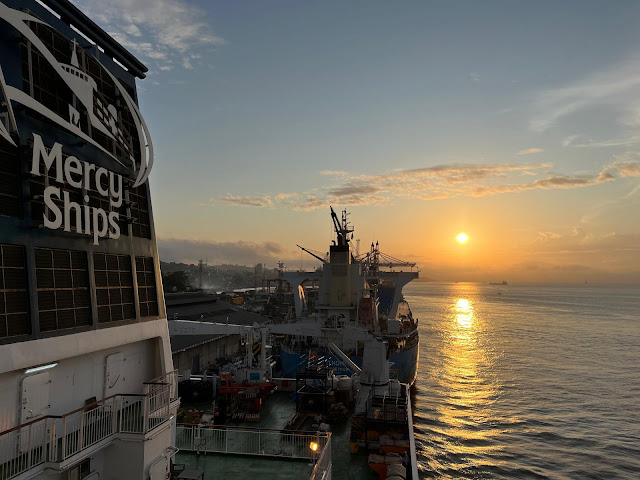
A morning view looking out over the bay. The lifeboat (orange) is a constant reminder for diligence and that we're at sea

A graceful sunset. A reminder friends back home are approaching mid-day


Monday, September 2, 2024

Opening the Hospital!


Life here on the Global Mercy is getting busy. We have been in Sierra Leone for around 3 weeks now and all the preparation for the hospital to open is completed. The first patients come on board today and the first surgery will be performed tomorrow morning. You may be thinking "What have you been doing for those 3 weeks? Didn't they just do surgery there this past Spring?"


                          Our family representing the USA while sailing into port!


Well, the amount of cleaning, organizing and preparation that needs to be done has surprised us all. We have all been able to volunteer in different ways to help get the hospital open. 

Lauren and other 6-12th graders had fun cleaning floors and walls.

Jaclyn has been helping in the rehab department with cleaning, organizing materials and getting to know her coworkers. 

The hospital also hosted an "open house" last week geared toward kids so they could see what happens downstairs. This was all done in a family friendly way with M&Ms being medicine, gummy bears in patients bellies, etc. 


                    Surgeon Sam scrubbing in for surgery!


                    "What do you think Doctor Sadie?"


        Nurse Lauren learning to take patients blood pressure

Although this is seen as a fun event for kids, it also brought good conversation afterward. Kids saw just how many "stations" patients move through while here (pre-op, surgery, PACU, rehab, etc). Our kids also got excited about how we can visit and play with kids while they are healing. It is easy to move through our days of school, meals, homework, fun with friends and not think about the whole reason we are here-to bring hope and healing! 

Another event I (sadly) did not get photos of was the hospital prayer walk last week. 15 groups of approximately 10 people each went through each room of the hospital and prayed for the people who will work there (doctors, nurses, chaplains, etc) and patients as they serve. It was a special time to show how preparations are not only physical preparations but mental/spiritual as well. 

I'll end this with a few more photos of life here lately-

First day of school!

Lauren while sailing in!

Sadie and new friends

Jeff playing pickle ball on the ship

Sam loves hot chocolate from the cafe

Lauren and new friends

Thank you all for your thoughts, prayers, texts of encouragement, etc. We are thankful for all of you partnering with us. 

Love, J^2 L S^2